
💡 Published: 11/17/2025 | 📅 Last Updated: 11/19/2025
Trust vs Will is the question for Estate Planning today. With the drastic changes in banking and court systems, Wills are no longer good enough.
—————
Protect Your Family’s Future – See the Solutions We Recommend
—————
What is the Best Trust to Avoid Probate?
—————
Table of Contents
—————
Trust vs Will – Which is Best for You?

Estate planning has changed dramatically over the last several decades. What worked for older generations is not enough to protect families today. With new banking regulations, changing court procedures, rising costs, and more complex family structures, relying on a basic WILL can leave families vulnerable to delays, financial hardship, conflict and additional emotional stress.
This is where you will need to know more about Trusts and how they work. Learn the difference between Revocable and Irrevocable Trusts. Many families find themselves lost when a family member dies – due to lack of preparation and knowledge about how WILLS and TRUSTS actually work. Because they have not educated themselves on this subject, they have relied on the previously known process, relying on what their parents and/or grandparents did.
Only the ones who are keeping up with the change of times and procedures with the banking and court systems are prepared. They know how to avoid frozen bank accounts after death and how to design private inheritance planning without probate court. They also know which is the best trust to avoid probate entirely. We would like to get you prepared.
—————
Grieving Families Have Enough To Deal With

When we are suddenly faced with death in the family – it hits hard! And most of the time we are not prepared. We are so distraught that we are nowhere in the mindset of making funeral arrangements. It is a dreadfully shocking experience, especially if the deceased was not sick. This happens more often than not and many are not ready for it.
The costs of burial and funerals have increased drastically over the years. In most recent years, many have opted for cremation because it was less expensive. However, now the price of cremations have increased to where they are unaffordable for many. Something just has to give. There has to be a way for families to avoid frozen bank accounts after death and have the ability to prepare for a decent funeral.
—————
Pre-Needs Program – To Cover Burial Expenses
Mortuaries have attempted to solve this problem by offering a Pre-Needs program. This is an arrangement between you and the Funeral Home giving you the option to plan and pay for your funeral expenses, or that of a loved one, in advance. It allows you to make decisions about the services and choosing the casket and style of service prior to the inevitable, so that your family can be relieved of the financial and emotional burdens at the time.
This makes it so much easier for families that lack the financial means to bury their loved ones. You can either pay for the pre-needs program with a lump sum – or you can make monthly payments. These funds are usually held in a trust or a life insurance policy designed to cover the funeral expenses. If you pay in advance, this could lock-in the current prices which can potentially save you money in case of inflation.

This gives most families “Peace of Mind” knowing that the wishes of the deceased are met, ensuring that your loved ones are not stuck with making the difficult decisions during their time of grief.
—————
Why a Will Is No Longer Enough in Today’s World
A will plays an important role in communicating your wishes, however it has major limitations that many are not aware of. My husband and I have already experienced this problem since 2021, when his uncle died – and till this day it still is not resolved. The court makes it so difficult – as if they deliberately refuse to provide the permissions you need to proceed. The banks will not give you any type of information about the decedent’s account – even if you have the death certificate. It is their policy not to provide any information unless you are the POD (beneficiary) on the account.
Most people are not aware that:
❌ A Will does not avoid probate
Probate is the court-supervised process required to validate a Will. It can take months – or years – while your family waits for the probate courts permission to access what you left them.
❌ A Will becomes public record
Anyone can see what you owned and who received what, leaving your family exposed to disputes and financial predators.
❌ A Will offers no lifetime protection
If you become incapacitated, a Will does nothing to help manage your money, property, or medical decisions.
❌ A Will provides limited protection against family conflicts.
Without a Trust, families often fight over funeral costs, property, responsibilities, and inheritance details. In today’s legal and financial environment, a will alone leaves too many gaps.
—————
What is a Pour-Over Will?

A pour-over will is what you would use in conjunction with a living trust. It is a legal document that covers any asset that was accidently left out of the trust and transfers it into the trust after the owner’s death. This works well because after your trust is created, many fail to fund the trust properly.
The pour-over trust functions as a safety net instructing the probate court to “pour over” these remaining assets into the trust, in order for the intended distribution as instructed by the trust, according to the terms of the trust, instead of the courts instruction. Unfortunately the pour-over will is subject to probate court before the assets are permitted to be moved over into the trust.
How it Works
- It works with a Trust. It is created alongside a living trust ensuring that all assets are managed by the trust.
- Transfers forgotten assets. If during your lifetime, you forget to transfer your assets into your trust, the pour-over will directs the executor to move them over after your death.
- Assets are “poured over.” The trust manages the distribution to the beneficiaries only after the assets have been transferred over.
—————
Why a TRUST Has Become Essential For Modern Estate Planning

In current times, when a person deceases – it is mandatory for the family to open an estate account. And most likely they will need a lawyer to help them with the probate process. You can do this on your own but it is very difficult, and the courts do not make it easy for you, let alone help you. They are quick to say they are not attorneys and cannot give you any advice. If you are new to this, it can be very stressful and aggravating. It would make life after the death of a loved one much easier if you didn’t have to deal with the probate courts.
✅ 1. A Trust avoids probate completely
- No court delays
- No legal fees
- No stress on the family
- No public exposure
Assets transfer smoothly and quietly without any hassles.
✅ 2. A Trust protects your family from financial hardships
When a loved one passes, families often face:
- Frozen bank accounts
- Immediate funeral costs
- Emergency expenses
- Property disputes
A Trust ensures your family has immediate access to what they need without blockage from the bank and/or court. It’s good to have to avoid frozen bank accounts after death.
✅ 3. A Trust helps reduce family conflict
By providing clear instructions and designating a Trustee, a trust eliminates the guesswork that causes arguments and emotional strain.
✅ 4. A Trust protects you throughout your lifetime
If you become ill or unable to manage your affairs, a trust assures the person you appoint can step in – without involving the courts.
—————
✅ Types of Trusts: Which One Give the Best Protection
Learn the Difference between Revocable and Irrevocable Trusts and the Best Trust to Avoid Probate Entirely!
The Difference between Revocable and Irrevocable Trusts

Not all trusts are equal, providing the best benefits. For many, when a trust is mentioned they think you are speaking in a foreign language. Why? Because they have no clue about them and what they are for, or even why they need one. But it’s not their fault. It’s not something that is taught in schools or even in economics and finance in college. It’s mostly passed down among elite families. And we don’t know about it because it’s not made aware to us. Most have never heard of a Trust, let alone the difference between Revocable and Irrevocable Trusts. We’ll share that with you here.
Here is a simple breakdown.
—–
- Revocable Living Trust (this is the most common)
You can change it anytime. You stay in control while alive.
Benefits:
- Avoids probate
- Maintains privacy
- Provides smooth inheritance
- Allows management during incapacity
Limitations:
- No lawsuit protection
- No creditor protection
Best for: Families wanting probate avoidance and ease.
Learn the truth about Living Trusts in this video Here
—–
2. Irrevocable Trusts (High Protection)
Cannot be easily changed – making it much stronger legally

Benefits:
- Excellent lawsuit protection
- Creditors cannot access assets
- Removes assets from taxable estate
- Protects long-term family wealth
Best for: People wanting asset protection and generational planning.
—–
3. Asset Protection Trust (APT) – “Bulletproof Trust”
Designed to legally separate your assets from personal risk
Types:
- Domestic APT’s (Nevada, Wyoming, Alaska, and South Dakota)
- Foreign APT’s (Cook Islands – extremely strong)
Advantages:

- Very difficult for courts or creditors to penetrate
- Strong shield for business owners and families
- Ideal for high-risk careers or wealth preservation
Best for: Maximum protection from lawsuits and judgements.
—–
4. Testamentary Trusts
Created through a Will. Activates only after death.
This however, Still Requires Probate.
Best for: Protecting minor children
—–
5. Special Needs Trusts
Protects disabled beneficiaries without affecting benefits.
—–
6. Spendthrift Trusts
Prevents heir from losing assets to creditors or wasteful habits.
Often used inside larger Irrevocable Trusts.
—————
Get the Free Estate Planning Checklist
Learn How to Protect Your Assets and Finances with – The “BULLETPROOF TRUST”
In this Free Workshop you will learn the following:

- How to Law-Suit Proof Your Assets, Money and Home from Seizure!
- How to Avoid Probate taxes, Inheritance taxes, and more…
- How anyone can do it Without being a Lawyer or Expert!
Learn how to pay 0% in taxes legally just like the elite do.
This is the best trust to avoid probate entirely. You benefit from private inheritance planning without probate court interference. Making it easier to avoid frozen bank accounts after death.
The Secret Revealed
This is the secret information they didn’t want us to know about – is now available to all
A proven program designed by a team of attorneys who created the Rockefeller Trust has made this information available for others. This program enables You, the fortunate opportunity to protect your assets and finances the same way the elites do for a nominally low cost.
Find out how you can protect yourself and family members just as the elite do. This Free Online Workshop will inform you of what you need to know. What the elite would rather you not know. Register Here for the Free Workshop to learn all the Secrets of the Bulletproof Trust.
—————
You Don’t Have to Be Rich to Create and/or Benefit from a Bulletproof Trust
Anyone can create a Bulletproof trust. You don’t have to have a lot of money in the bank to protect your assets. Literally anyone who wants privacy, and protection from the probate court infringing on your bank account and assets. This enables your loved ones to be able to access your finances and assets without interruption from the banks and probate courts.
—————
✅ Which Trust Is Best for Bulletproof Protection?

For families wanting the strongest legal shield, the ranking is:
🥇 Top Protection: Irrevocable Asset Protection Trust (APT)
Especially in strong jurisdictions like Nevada or Wyoming.
🥈 Next Best: Irrevocable Family Trust or Dynasty Trust
Ideal for long-term wealth preservation.
🥉 Foundation Trust: Revocable Living Trust
Great for avoiding probate and reducing family conflict.
Many families choose to use both, a Revocable Living Trust and an Irrevocable/APT Trust for layered protection
—————
There Are Two Categories that Trusts Fall Into:
Statutory Trusts vs Constitutional Trusts

The two categories of Trust fall into are the Statutory Trust and the Constitutional Trust (Private Express Trust Organization).
Today’s estate planning environment includes many types of trusts, but two categories are increasingly discussed – especially among families seeking maximum protection – are Statutory Trusts and Constitutional Trusts.
These two models differ significantly in how they are created, governed, and recognized under law. Understanding the distinctions helps families choose the structure that aligns with their goals, risk, tolerance, and long-term planning needs.
—————
✅ What is a Statutory Trust?
A Statutory Trust also known as a statutory business trust or statutory entity trust) is a trust that is created and governed under state statutes. What this means is:
- It is formed under the laws of a specific state
- It must comply with state rules and reporting requirements
- The powers of the trust, trustee, and beneficiaries are defined by statute
- The trust has a legal identity recognized by state courts
- It may have mandatory filings or documentation
Common Characteristics of Statutory Trusts
- Created under state law (ex: Delaware Statutory Trusts, Nevada Trust, Wyoming Trust)
- Often used in business, investment, or asset-holding structure
- Most follow state-imposed regulations
- More predictable and traditional in estate planning
- Easy to administer
- Often recognized by financial institutions, banks, and courts
—–
Primary Uses:
- Asset Protection (if irrevocable)
- Real estate investments (DST’s are common in 1031 exchanges)
- Family Trusts for probate avoidance
- Business Holding Trusts
- Estate Planning for ease and simplicity
—–
✅ Who Benefits More from Statutory Trusts?

Statutory Trusts are ideal for:
- Families wanting a straightforward, court recognized structure
- Individuals needing a trust accepted by all banks and institutions
- Investors using trusts for business, real estate, or for 1031 exchanges
- Families wanting formal governance and legal predictability
- Those who prefer a trust recognized by statutory case law and the traditional legal system
—————
Learn about Private Inheritance Planning Without Probate Court – Avoid Frozen Bank Accounts After Death!

—————
✅ What is a Constitutional Trust?
A Constitutional trust is a trust that is not created by state statute, but instead:

- Formed under natural rights, contract rights, or private trust principals
- Governed by private contract law (Article I, Section 10 of the U.S. Constitution)
- Exists as a private non-statutory entity
- Not dependent on state statute for authority
- Does not require state filings or registrations
- Operates as a private contract between the grantor and the trustee
Constitutional Trusts Rely on:
- Common-law trust principles
- Contractual rights protected under the Constitution
- Private agreements between parties
They are Sometimes Referred to as:
- Non-Statutory Trusts
- Common-law Trusts
- Private Express Trusts
- Constitutional contract trusts
—–
Key Characteristics of Constitutional Trusts:
- Private, contract-based structure
- Not registered with the state
- Not dependent on statute for existence
- Maintains great privacy
- Often used by families seeking maximum separation from government systems
- Can provide strong layers of protection if properly structured and administered
—–
✅ Who Benefits Most from Constitutional Trusts?

Constitutional Trusts are ideal for:
- Individuals seeking maximum privacy
- Families who want to operate outside statutory oversight
- People concerned about state intrusion, court access, or financial surveillance
- Those using “lawful money” principles, or private banking structures
- Anyone seeking additional layers of asset separation
- People with philosophical or sovereignty-based financial interests
- Private inheritance planning without probate court
In Short:
Constitutional Trusts are the best trust to avoid probate entirely; best for privacy focused individuals who prefer private contracts over statutory frameworks.
—————
Get The Best Trust Known For The Best Protection

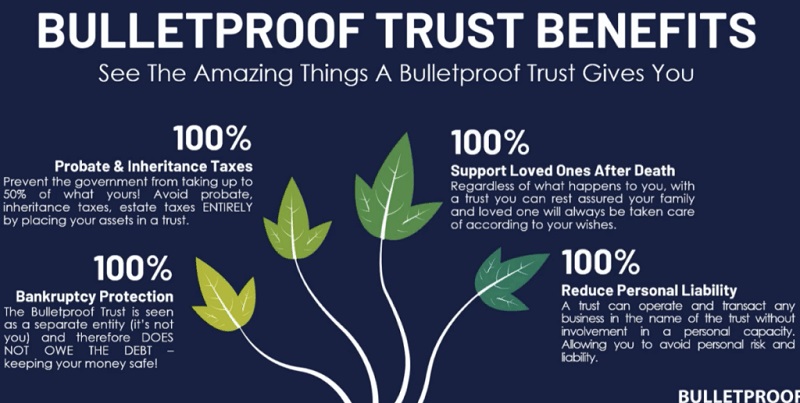
ARM YOURSELF NOW! – GAIN ACCESS TO THE SAME TYPE OF TRUST USED BY THE ROCKEFELLERS
—————
The cost is only $997.00 (A Value of $28,979) made available to you at a fraction of the cost. Most trusts drawn up by attorneys average between a minimum of $2000 and up to $10,000, and even more depending on your needs – especially if you create a Trust Web (which we highly recommend). The “Bulletproof Trust” offered by Private Wealth Academy avails to you the opportunity to create an unlimited amount of trusts, saving you thousands.

It also educates you on how to create a Trust Web – the key in making your Trust Bulletproof. I have used this program to create a trust web for my family. There is a ton of essential information here that is crucial to your acknowledgement for total protection. It is a great program offering so much useful information that you can implement for yourself and your family. There are a series of videos to watch. And the good thing is you can stop it, rewind it, and listen to it as many times as you need.
You are given email access to ask questions to get a better understanding of the information that is provided to you. They even also provide certain forms that are necessary for your use. If you listen attentively and put what you have learned into action then you are way ahead of the curve than many. Come out of the dark and into the light. Learn the truth about what is going on around you. You will definitely get a wide awakening of how things actually work in the financial world.
Now, I must warn you. ‘They will try to upsell you with their other products – as most companies do. If you have the extra funds to purchase the additional programs at the lowered offering price. It is advantageous to go ahead and do so at that time, otherwise you will pay the full price of the program if you wait until later. However, if you only want the Bulletproof Trust Secrets program, then simply decline the additional offers and continue through with the checkout process. Once you have completed your purchase the program is instantly available to you.
—————
✅ The Core Differences Between Statutory and Constitutional Trusts
| Feature | Statutory Trust | Constitutional Trust |
|---|---|---|
| Legal Foundation | Created under state statutes | Created under private contract law (Constitution Art. I §10) |
| Public vs Private | Public legal recognition | Private, non-statutory |
| Control | Defined by state rules | Defined by private contract |
| Court Jurisdiction | State probate/civil courts have easier access | Courts have limited access depending on structure |
| Reporting Requirements | Sometimes required | Usually none |
| Best Use | Traditional estate planning | Privacy and advanced asset protection |
| Banking Recognition | Universally accepted | May require specialized planning |
| Asset Protection | Strong, especially with irrevocable/APTs | Strong if structured with private law protections |
| Cost & Complexity | Generally simpler | Requires more specialized expertise |
—————
✅ Which One Should a Family Choose?
Choose a Statutory Trust if you want:
- A simple, court recognized trust
- Easy interaction with banks and institutions
- A traditional revocable or irrevocable structure
- A trust for holding real estate or investments
- A trust primarily to avoid probate and manage assets
This applies to 90% of families
Choose a Constitutional Trust if you want:
- Maximum privacy and separation
- A trust not governed by state statutory powers
- Avoid frozen bank accounts after death
- A trust based on contract private rights
- Protection from increased government intervention
- Alignment with lawful money or private wealth strategies
- A legacy structure outside the standard statutory system
- This is popular among families who want higher levels of control and privacy
—————
✅ Can a Family Use Both?
Yes – and many do
A common strategy is:
- A Statutory Irrevocable Trust
For probate avoidance and lifetime management
2. A Private/Constitutional Irrevocable Trust
For deep asset protection and legacy preservation
This two-trust strategy gives families the benefit of both systems
—————
✅ Quick Comparison Trust vs Will
| Feature | Will | Trust |
|---|---|---|
| Avoids Probate | ❌ No | ✅ Yes |
| Private | ❌ No | ✅ Yes |
| Lifetime Protection | ❌ No | ✅ Yes |
| Asset Protection | ❌ Minimal | ✅ Strong (Irrevocable/APT) |
| Helps Prevent Conflict | ⚠️ Limited | ✅ Strong |
| Fast Access to Funds | ❌ Delayed | ✅ Immediate |
| Best for Modern Estate Planning | ⚠️ Outdated Alone | ✅ Highly Recommended |
—————
Trust vs Will – A Trust Can Be Your New Best Friend
A Trust has now become the most important tool for your family’s Estate Planning and Asset Protection. Most people lack the knowledge of trust vs will. Many families are now realizing how important it is to establish a Trust for the protection of the families financial assets. Bringing this awareness to you will help you and your family to understand better and make more educated choices when planning for your future.

In my time, a Will was the way to go. All you needed was a Death Certificate, Will and a “Next of Kin Affidavit” from the banks, and you could carry out the wishes of your deceased loved one. Yes, there may have been family disputes, but it was handled without the interference of the probate courts. Well, not anymore. Today a will is no longer a means of protection. They can easily be contested and usually lead to probate. The banks require you to open an estate account for the deceased in conjunction with the court’s ruling.
—————
✅ Frequently Asked Questions about Trust vs Will
- Q: Do I still need a Will if I have a Trust?
- A: Yes: a “pour-over will” protects assets that weren’t added to the Trust yet.
- Q: What is the strongest Trust for asset protection?
- A: An Irrevocable Asset Protection Trust (APT) in a strong jurisdiction (Nevada, Wyoming, etc.)
- Q: Does a Trust avoid probate?
- A: YES! – 100 percent, as long as the assets are properly placed inside the trust.
- Q: Are trusts only for wealthy people?
- A: No Today trusts are extremely common for middle-class families because they protect homes, savings and family assets.
- Q: Does a trust protect against lawsuits?
- A: A Revocable Trust does not, but an Irrevocable or Asset Protection Trust DOES.
- Q: What happens if I become incapacitated?
- A: Your Trustee can immediately step in – without court involvement – if you have a living will.
- Q: Why is Estate Planning so different today?
- A: Because of new regulations, higher costs, more digital assets, blended families, and stricter banking processes. And not to mention the greed of the governments.
- Q: How often should I update my trust?
- A: Every 2 -3 years, or after major life events.
—————
Conclusion: Trust vs Will
After learning the difference between revocable and irrevocable trusts and Statutory versus Constitutional trusts I have deduced that the “Bulletproof” Trust is the best for Private inheritance planning without probate court. The courts do nothing but cause additional problems and make it much more difficult to handle the affairs of your loved ones. Don’t let this happen to you. Get the Best Trust to Avoid probate entirely and avoid frozen bank accounts after death. Now there should be no question about trust vs will.
—————

Register Here 👉 👉 👉 for the Free Workshop to Learn the Bulletproof Trust Secrets Today!
Begin your journey of financial security in estate planning and asset protection with the Bulletproof Trust. Shield yourself from probate courts and frozen bank accounts today!
If you are ready to create your Bulletproof Trust just Tap the Button Below:

—————
Secure Your Family’s Financial Future – Learn about Multiple Streams of Income
Looking to increase your financial assets? Tap onto the button below to learn how to build multiple streams of income with a Marketing Professional who has done just that and is willing to show you.
—————
Updated Content 11/19/2025